
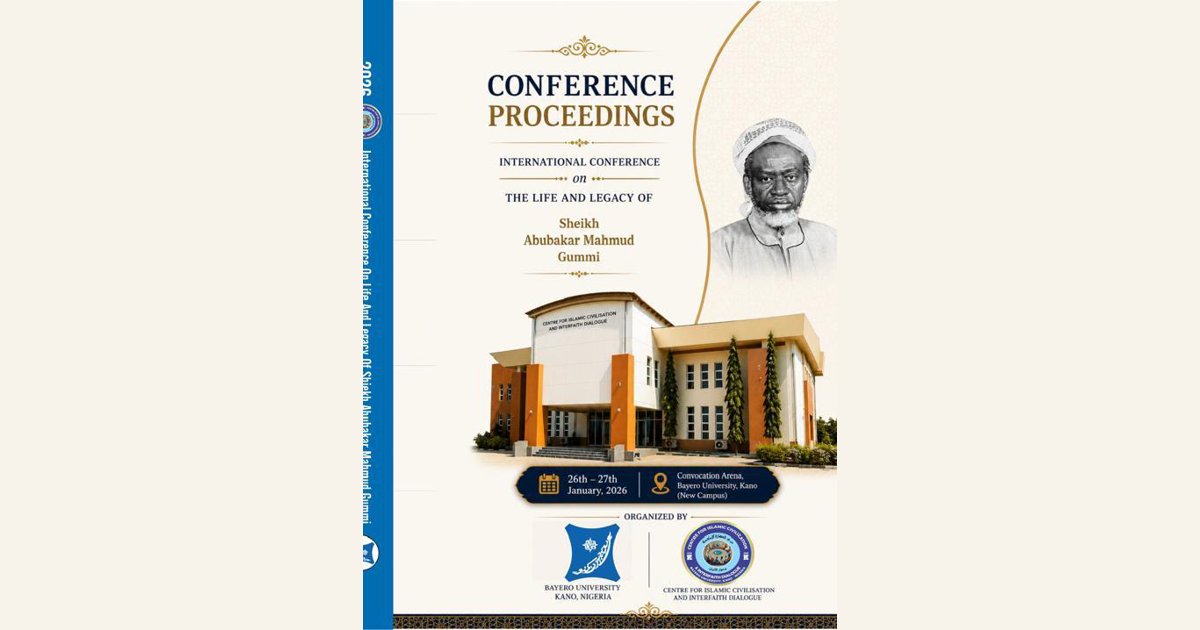
provided a framework for his millions of disciples to navigate the complexities of secular, multireligious governance in Nigeria. His teachings profoundly shaped the political consciousness of a generation of Northern Muslims, particularly concerning their role and responsibilities within the democratic process. This paper seeks to analyze how Sheikh Abubakar Gumi's specific brand of sectoral leadership and his distinct political philosophy influenced the voting behavior of his disciples. The central thesis is that Gumi successfully mobilized his followers by framing democratic participation as a religious duty, advocating for the election of Muslim candidates ("zaɓenMusulunci") as a means of protecting and promoting Islamic interests within Nigeria's secular state structure. This analysis will explore the methods he employed and the enduring impact of his ideology on contemporary Nigerian politics. 2. Conceptual Clarification i. Sectoral Leadership Sectoral leadership refers to influence and authority exercised within a specific domain or "sector" of society, rather than across the entire political or national spectrum. Instead of seeking broad executive power, a sectoral leader focuses on a specialized area such as religion, labor unions, academia, or industry.Their power is derived from expertise or moral authority within that niche.A prominent cleric (like an Imam) often functions as a sectoral leader, influencing their followers' social and political views without necessarily holding an elective office. ii. Political Philosophy This is the branch of philosophy that explores fundamental questions about the state, government, justice, and liberty. It isn't just about how politics is practiced, but how it ought to be practiced.It examines the legitimacy of authority, the rights of citizens, and the best way to organize a society.Examples of such includes, Liberalism, Marxism, and Communalism are all political philosophies that propose different ways for people to live together under a government. iii. Sheikh Abubakar Gumi (1922–1992) Sheikh Abubakar Gumi was a pivotal Nigerian Islamic scholar and a reformer who fundamentally changed the landscape of Northern Nigerian politics and religion.He was among the co-founders of the Izala movement (Yan Izala), which sought to "purify" Islam from what he saw as local innovations (Bid’ah).He believed that Muslims must participate in the democratic process to protect their interests, bridging the gap between traditional Islamic scholarship and modern state politics. iv. Voting Behavior Voting behavior is the study of why and how people vote. It analyzes the psychological, social, and economic factors that influence a citizen’s choice at the ballot box.In Nigeria,voting behavior is often influenced by primordial factors (ethnicity and religion) rather than purely on policy or ideology. This is frequently referred to as "bloc voting."
v. Nigerian Democracy
Nigerian democracy refers to the specific system of governance adopted by Nigeria, most notably the return to civil rule. Nigeria is a federal republic modeled after the United States system, featuring a President, a bicameral National Assembly, and an independent Judiciary.It is characterized by the "federal character" principle, which aims to ensure that no single ethnic group or region dominates the federal government. vi. Political Islam Political Islam (or Islamism) is a set of ideologies holding that Islam should guide social and political as well as personal life. It suggests that the legal and political systems of a country should be based on Islamic law (Sharia).This manifested strongly in the early 2000s when several Northern states adopted expanded Sharia legal codes, creating a complex dialogue between religious identity and the secular constitution. vii. Identity Politics Identity politics involves political positions and mobilization based on the interests and perspectives of social groups with which people identify. These identities can be based on ethnicity, religion, gender, or social class.Nigeria is a multi-ethnic and multi-religious state, identity politics is the primary driver of political competition. Voters often feel that they are represented only when "one of their own" (in terms of tribe or faith) is in power. 3. Conceptual Framework: Sectoral Leadership and Political Philosophy Sectoral leadership in the Nigerian context refers to the exercise of authority and influence by non-state actors over distinct segments of the population, typically defined by ethnicity, religion, or region (Bach, 2011). These leaders command loyalty and trust that often rivals or exceeds that given to formal state institutions. Their power is derived from their perceived authenticity, moral authority, and commitment to the group's interests. In a political system where trust in formal institutions is low and ethnic and religious cleavages are deep, sectoral leaders become indispensable for political mobilization (Suleiman & Othman, 2018). They translate complex political issues into simple, relatable narratives that align with their followers' worldviews, thereby guiding their political choices. Political philosophy, in this context, is not merely an abstract set of ideals but a practical framework that informs a group's engagement with the state and its institutions (Kukah, 1993). For religious leaders like Gumi, political philosophy is intrinsically linked to theology. It answers fundamental questions about the legitimacy of secular governance, the role of Muslims in a multi-religious society, and the criteria for selecting political leaders. This philosophy provides the ideological justification for political action, transforming the act of voting from a simple civic exercise into a moral or religious obligation. 4. Research Questions a) To what extent did Sheikh Abubakar Mahmoud Gumi’s interpretation of Islamic political philosophy redefine the concepts of "civic duty" and "leadership" for his disciples within the context of Nigeria’s Second Republic?
b) What specific communication channels such as Tafsir sessions, radio broadcasts, and printed literature did Sheikh Gumi utilize to translate religious authority into political mobilization? c) How did Sheikh Gumi’s reformist political stance challenge the traditional voting blocs historically controlled by the Sufi brotherhoods and the Sarauta (traditional aristocracy) in Northern Nigeria? 5. Research Assumptions a) The spiritual authority of Sheikh Abubakar Mahmoud Gumi was not confined to theology but naturally extended into the socio-political sphere, creating a "sectoral leadership" that disciples viewed as authoritative for civic decision-making. b) Disciples of Sheikh Gumi shared a relatively uniform understanding of his political philosophy, and that his shared ideological framework acted as a primary determinant in their collective voting behavior. c) The disciples' voting patterns were not merely passive or accidental but were conscious acts of political agency driven by the desire to align their democratic participation with the Sheikh’s Islamic political thought. 6. Sheikh Abubakar Gumi: The Scholar and His Philosophy Sheikh Gumi’s career spanned the late colonial period and the first three decades of Nigeria's independence, a period of immense political and social transformation. His background as a respected jurist and scholar, combined with his charismatic preaching style, enabled him to cultivate a massive following, particularly through the Izala movement, which he co-founded in the 1970s (Loimeier, 2016). The Izala movement sought to "purify" Islamic practice from what it considered innovations (bid'a) and return to the pristine teachings of the Qur'an and Sunnah. Gumi's political philosophy was shaped by his deep-seated conviction that Muslims had a divine mandate to ensure that governance, even within a secular framework, did not contradict Islamic principles. A central tenet of his political thought was the imperative of Muslim unity in the political sphere. He was famously critical of ethnic divisions among Northern Muslims, arguing that their shared religious identity should be the primary basis for political solidarity (Paden, 2008). His most direct and controversial intervention in politics was his advocacy for what his followers termed "zaɓenMusulunci"the strategic election of a Muslim leader to preside over the country. Gumi (1992) famously articulated this in his autobiography, ‘Where I Stand’, where he argued that a Muslim should not accept a non-Muslim as a leader in a country with a significant Muslim population. He posited that a Muslim leader, regardless of their piety, would be more inclined to protect the interests of the Muslim community than a non-Muslim one. This philosophy provided a clear, unambiguous directive to his followers: the primary criterion for selecting a presidential candidate was their religious faith. 7. Methodology
This paper adopts a historical-descriptive approach combined with thematic analysis. This would allow for a trace on Gumi’s public pronouncements and correlate them with the political climate of the Nigerian Second Republic (1979–1983) and the aborted Third Republic.To ensure "triangulation" (validity), the paper uses a mix of primary and secondary sources. For the primary sources the following were consulted: i.Archival Content Analysis: Analyze transcripts or audio recordings of Gumi’s Friday sermons
(Tafsir) and his radio broadcasts (such as those on Kaduna DRTV). ii.Key Informant Interviews (KIIs): Conducted semi-structured interviews with:
a. Surviving elders of the JIBWIS (Izala) movement who worked directly with him. b. Political contemporaries who sought his endorsement. c. Academics specializing in Islamic political thought in Northern Nigeria. iii.Documents: Examination of his seminal writings, specifically ‘Tarikh al-Islam’ or his autobiography, ‘Where I Stand’, to extract his political philosophy. For the Secondary Sources, the paper consulted peer-reviewed journals on Nigerian democratic history, biographies and independent critiques of the Izala movement, as well as election result data from the 1979 and 1983 elections in states where his influence was strongest (e.g., Kaduna, Sokoto, Kano). In an attempt to make sense of the data, Thematic Content Analysis was adopted. Starting by Identify recurring themes in Gumi's speeches (e.g., "The necessity of Muslim unity in politics," "The rejection of traditionalist orders/Sufism in governance"). Followed by correlating the timing of his endorsements with shifts in voting blocs or political party alliances (like the NPN or GNPP). Then these findings were placed within the broader context of the Nigerian constitution and the secular vs. religious debate of the era. Clearly, the timeline of this study is 1978 – 1992, being the most active political period analyzed. While his influence continues through his successors, this paper focuses on his direct leadership period. 8. Mechanisms of Influence on Voting Behavior Sheikh Gumi employed several interconnected mechanisms to translate his political philosophy into tangible voting patterns among his disciples. 8.1. The Pulpit and Public Preaching The primary vehicle for Gumi's influence was the sermon (khutbah) delivered in mosques and at large public gatherings. His Tafsir (Qur'anic exegesis) sessions, especially during Ramadan, were broadcast widely via radio and audio cassettes, reaching millions across Northern Nigeria and beyond (Umar, 2001). In these sessions, Gumi seamlessly blended theological interpretation with contemporary political commentary. He used scriptural passages to frame political contests as struggles between forces of righteousness (Islam) and ignorance (jahiliyyah), urging his followers to participate in elections as a collective duty to enthrone leaders who would be sympathetic to their faith. 8.2. Media Engagement and Publications Beyond the pulpit, Gumi was a skilled user of modern media. His interviews with national and international news outlets, such as the BBC Hausa Service, provided him with a platform to project his views to a wider audience. His autobiography, ‘Where I Stand’, served as a political manifesto, codifying his views on leadership, the state, and the role of Muslims in Nigerian politics (Gumi, 1992). These publications and media appearances reinforced his message, ensuring its dissemination beyond the immediate circle of his disciples and embedding it within the broader political discourse of Northern Nigeria. 8.3. The Izala Movement as a Mobilization Structure The Izala movement provided an institutional framework for Gumi's political project. With a network of mosques, schools, and preachers across the country, the movement served as a ready-made structure for political mobilization (Loimeier, 2016). Izala clerics, trained and influenced by Gumi, echoed his political messages in their local communities, creating a cascade of influence from the center to the grassroots. This network was particularly effective in rural areas, where the local Imam is often the most trusted source of information and guidance. During election periods, this network could be activated to disseminate endorsements and mobilize the faithful to vote in a coordinated manner. 8.4. Framing Elections as a Religious Imperative Gumi's most significant achievement was arguably his success in framing the vote as an act of faith. By presenting the choice between a Muslim and a non-Muslim candidate as a choice between the success and failure of the Muslim Ummah (community), he elevated the stakes of democratic participation. For his disciples, voting was no longer a matter of evaluating policy platforms or party manifestos but a religious obligation to ensure Muslim leadership. This framing proved exceptionally powerful during the politically charged Second Republic (1979- 1983) and the transition program of the late 1980s and early 1990s, where his support or opposition was seen as a critical factor in determining electoral outcomes in the North (Kukah, 1993). 9. Theoretical Framework This paper adopted the Theory of Mediated Theocratic Solidarity. Itis a conceptual framework proposed by scholar Anna Rowlands. The theory posits that in societies where religious identity is the primary lens for social organization, political behavior is not a product of individual "rational choice" but is "mediated" through a sectoral leader. Under this theory, the leader (like Sheikh Gumi) acts as a Political Intermediary who translates complex political landscapes into a moral and spiritual language that the disciples (followers) can act upon as a matter of religious obligation. In this light of this, the leader is perceived not just as a teacher, but as the protector of the sect’s specific interests. When Sheikh Gumi provided political guidance, it wasn't seen as "politics" by his disciples, but as a protective measure for the Ummah (community). Secondly, in a complex democracy, voters often face "information overload." This theory suggests the leader provides a "script" i.e. a simplified moral binary (e.g., "Candidate A aligns with our values; Candidate B does not") which the disciple adopts to reduce the cognitive burden of political decision-making. Thirdly,this pillar suggests that for the disciple, the act of voting according to the Sheikh’s preference is transformed into an act of piety. To vote against the leader’s counsel is seen as a breach of communal solidarity and a deviation from the "correct" path. To understand how this worked in the context of the paper, we can look at three specific mechanisms:
i. The "Izala" Institutional Effect Sheikh Gumi was viewed as an ideological father of the Izala movement. The theory suggests that his leadership wasn't just personal, but institutional. Because he built a structured movement, his political philosophy was disseminated through a network of mosques and schools, ensuring that his "sectoral leadership" was felt far beyond his immediate presence. ii. Radical Orthodoxy as Political Philosophy Gumi’s philosophy often emphasized a return to "pure" Islamic practice. The MTS Theory argues that this theological stance naturally led to a political philosophy of exclusivity and reform. His disciples voted for candidates they believed would facilitate this religious purification or protect the sect from traditionalist (Sufi) or secularist encroachment. iii. The "Fatwa" as a Voting Guide In Western democracies, endorsements are suggestions. In Gumi’s sphere of influence, his political pronouncements often carried the weight of a Fatwa (legal opinion). This creates a "locked-in" voting bloc that makes the sector a powerful force in Nigerian democratic negotiations. 10. Findings a. The study finds that Sheikh Gumi successfully reframed democratic participation which some conservative elements initially viewed as "un-Islamic" into a religious obligation. Gumi utilized the concept of ‘Maslaha’ (public interest), arguing that if "good Muslims" abstained from voting, they would be ruled by "bad leaders." This shifted his disciples’ behavior from political apathy or "purist" isolationism to active, mass mobilization during the Second and Third Republics. b. Unlike traditional Emirs who relied on palace structures, Gumi leveraged modern media to exert leadership across the "sector" of Islamic scholarship. His Tafsir sessions on Radio Nigeria Kaduna acted as a "virtual mosque," standardizing political thought across vast geographic areas. Disciples did not need physical proximity to the Sheikh to receive voting cues. The "radiofatwa" became a primary determinant of candidate viability in the eyes of his followers. c. The analysis reveals a significant disruption in the traditional power structure of Northern Nigeria. Gumi’s philosophy empowered the Yan Izala (his followers) to prioritize the Sheikh’s reformist ideology over the directives of traditional rulers (Emirs) or ethnic lineages. This created a "Block Voting" pattern. Candidates who secured Gumi's endorsement or even a subtle nod of approval often saw a disproportionate surge in support from the urban poor and the emerging middle-class intelligentsia in the North. d. Gumi’s political philosophy emphasized leadership traits that mirrored his own scholarly values i.e discipline, transparency, and a commitment to Islamic social justice. Disciples used a "Proxy Checklist" derived from Gumi's teachings to evaluate candidates. They looked for perceived personal piety and an affinity for the Sharia over specific economic manifestos. This forced secular politicians to adopt religious rhetoric and seek public audiences with the Sheikh to gain legitimacy, a phenomenon still prevalent in Nigerian politics today.
e. The findings suggest that while Gumi unified his disciples, his strong stances also triggered reactive voting behaviors in other sectors. The "Gumi Influence" was a double-edged sword. While it consolidated his base, it often led to a "Defensive Mobilization" by rival religious sects (such as the Sufi orders) and Christian minorities who felt threatened by his reformist zeal. His leadership inadvertently contributed to the religious bipolarization of the Nigerian voting landscape. 11. Discussion: Legacy and Implications for Nigerian Democracy The influence of Sheikh Gumi's political philosophy on the voting behavior of his disciples has had profound and lasting implications for Nigerian democracy. On one hand, his leadership encouraged political participation among a segment of the population that might have otherwise been apathetic, framing engagement with the secular state as a necessary endeavor. On the other hand, his emphasis on religious identity as the primary marker for political choice has contributed significantly to the deepening of religious cleavages in Nigerian politics. The "zaɓen Musulunci" doctrine reinforced the Christian-Muslim binary, transforming electoral contests into zero-sum religious battles (Suleiman & Othman, 2018). This has often made it difficult for candidates to build cross-cutting national coalitions based on ideology or policy. The legacy of this approach is evident in the informal but powerful convention of religious rotation ("power-sharing") for the presidency and vice-presidency between a Muslim and a Christian, a practice aimed at managing the very tensions that Gumi's philosophy highlighted. Furthermore, Gumi's model of sectoral leadership demonstrates the potent challenge that powerful non-state actors can pose to the development of a civic, secular national identity. When allegiance to a sectoral leader and a religious identity supersedes loyalty to the state and its democratic ideals, it can undermine national cohesion and foster a politics of exclusion. 12. Recommendations a. The study likely finds that disciples often prioritize the leader’s "fatwa" or political direction over independent manifesto evaluation. Hence, electoral bodies (like INEC) should partner with religious institutions to integrate civic education into religious curricula. This ensures that while disciples respect their leaders, they are also equipped with the critical thinking skills to evaluate candidates based on performance and policy rather than just endorsement. b. Sheikh Gumi represented a form of "Sectoral Leadership" where his influence spanned both spiritual and secular realms. Therefore, there is a need for a Code of Ethics for Religious Leaders regarding political endorsements. While freedom of speech is paramount, religious leaders should be encouraged to focus on "values-based" endorsements (e.g., integrity, justice) rather than "personality-based" endorsements, to prevent the polarization of the electorate along sectarian lines. c. The paper highlighted that Gumi’s influence stemmed from a gap where the state failed to provide moral or social direction. Thus, the Nigerian government should move from an adhocengagement with religious leaders during elections to a structured consultative framework. By involving sectoral leaders like Gumi (or his successors) in policy-making discussions yearround, the state can bridge the gap between "religious philosophy" and "democratic governance." d. Sheikh Gumi was among the pioneers in using mass media (radio and print) to reach his disciples. In this regard, regulations regarding political broadcasting should be updated to account for religious programming. There should be a clear distinction between spiritual guidance and partisan campaigning on public airwaves to ensure that the "sanctity of the pulpit" is not used as a tool for political coercion. 13. Conclusion Sheikh Abubakar Mahmoud Gumi stands as a towering figure in the histo

Comments